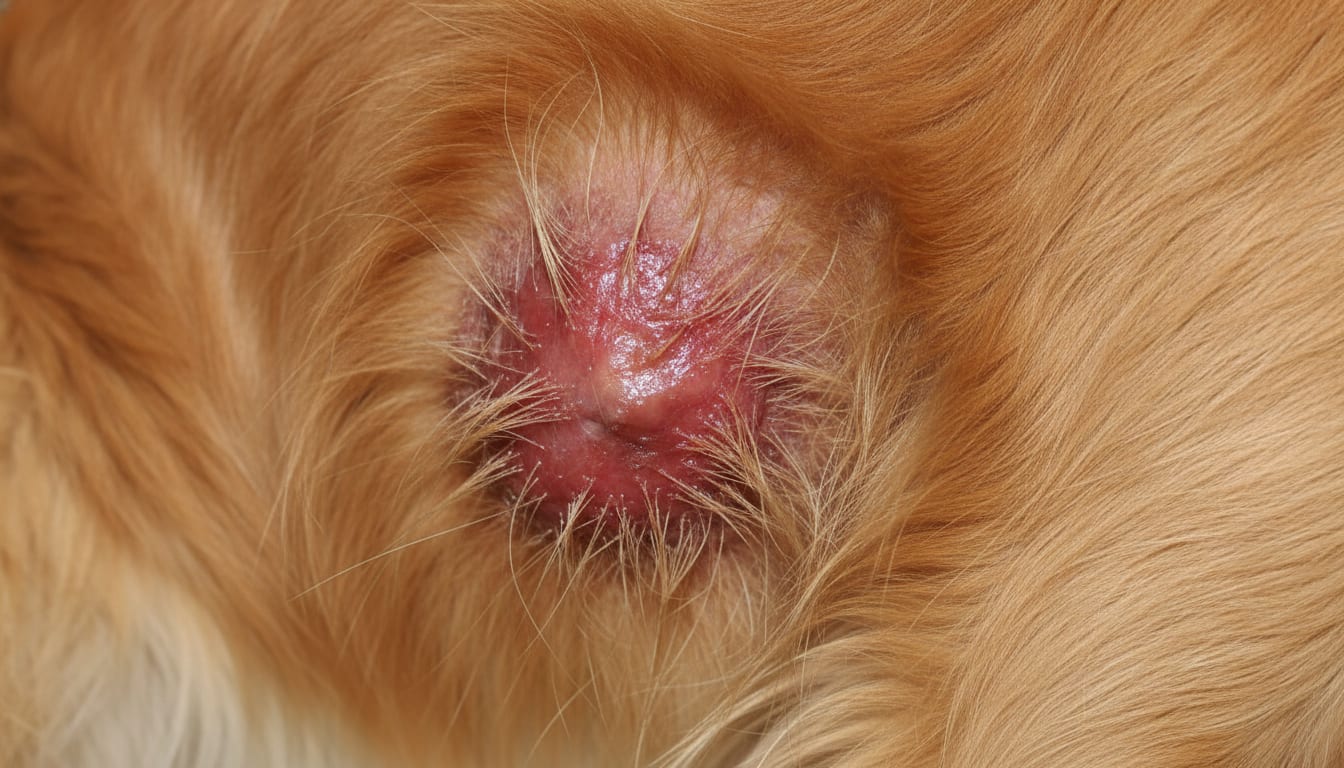
A hot spot can go from "huh, he's licking his leg a lot" to a raw, oozing, softball-sized mess in about six hours. That's not an exaggeration. It's the defining feature of the condition.
If you've never seen one, you will. If you have, you already know why we're writing this.

What a Hot Spot Actually Is
The clinical name is acute moist dermatitis (sometimes called pyotraumatic dermatitis). In plain English: it's a localized bacterial skin infection your pet created by licking, chewing, or scratching one spot until the skin barrier broke down.
The lesion is usually round, red, wet, and hairless in the middle. It smells bad. Your dog will absolutely not leave it alone.
Hot spots happen most often on dogs — thick-coated breeds like Golden Retrievers, Labs, German Shepherds, and Saint Bernards are prime candidates because trapped moisture under a dense coat is basically a bacterial incubator. But cats get them too. Cat hot spots tend to be smaller, hidden under fur, and often around the neck, base of the tail, or flanks. Because cats are fastidious groomers, owners frequently miss the lesion until it's well underway.
What Causes Hot Spots on Dogs (and Cats)
Something itches. Your pet licks. The licking damages the skin. Bacteria — mostly Staphylococcus species that already live harmlessly on the skin — take advantage of the broken barrier and multiply. That triggers more itch. More licking. More damage. This is the itch-lick-infect cycle, and it's why a small irritation becomes a saucer-sized wound overnight.
The trigger underneath is usually one of these:
- [Flea allergy dermatitis](flea allergy dermatitis) — the single most common cause. One flea bite on a sensitive dog is enough.
- [Environmental or food allergies](environmental or food allergies) — pollen, dust mites, chicken protein, whatever.
- [Ear infections](ear infections) — dogs scratch the side of their face and neck raw.
- [Anal gland issues](anal gland issues) — dogs chew at their rump.
- Moisture trapped in the coat — after swimming, bathing, or humid weather.
- [Boredom or anxiety licking](boredom or anxiety licking) — psychogenic hot spots, more common than people admit.
- [Matted fur](matted fur) — traps moisture and skin oils against the skin. Especially relevant for long-haired cats.
The hot spot is the symptom. Something else is the cause. Treating one without the other means it comes back.
[Chlorhexidine Gluconate 2%](chlorhexidine gluconate 2%): The Ingredient Doing All the Work
When vets treat a hot spot, they clip the surrounding fur, clean the lesion, and apply an antimicrobial. The antimicrobial is almost always chlorhexidine.
Chlorhexidine Gluconate 2% is a broad-spectrum antiseptic that kills bacteria (including Staph pseudintermedius, the usual hot spot culprit) and many yeasts by disrupting their cell membranes. It binds to skin proteins, which means it keeps working for hours after you rinse — this is called residual activity, and it's why chlorhexidine outperforms things like povidone-iodine or plain soap for skin infections. The 2% concentration is the standard vet-grade strength for medicated shampoos and is well-supported in veterinary dermatology literature (Merck Veterinary Manual, Pyoderma).
Paired with Ketoconazole 1%, an antifungal that inhibits ergosterol synthesis in yeast cell walls, you cover the bacterial and fungal sides of the equation at once. Yeast (Malassezia) often piggybacks on bacterial skin infections, especially in dogs with allergies or chronic ear issues.
That combination — CHG 2% + Keto 1% — is the formula in our Mav & Charlie Cleansing Shampoo and Cleansing Mousse. It's the same active-ingredient logic your vet's dermatology-line shampoo uses. There's no proprietary botanical mystery. It works because the chemistry works.
How to Treat Hot Spots on Dogs at Home
If the hot spot is small (under about the size of a quarter), fresh, and your pet is otherwise healthy, home care is reasonable. Here's the sequence:
- Clip the fur around the lesion. Use blunt-tip scissors or clippers. Air is the enemy of moisture, and fur traps moisture. Cats included — carefully.
- Clean the area. Warm water, gentle dab, no scrubbing. Pat dry.
- Apply a chlorhexidine-based cleanser. For a bathable dog, a full bath with Cleansing Shampoo works. For a spot lesion or a cat, Cleansing Mousse is easier — no water, no wrestling.
- Let it dry fully. Do not bandage. Hot spots heal faster exposed to air.
- Stop the licking. An e-collar (the cone) is unglamorous but non-negotiable. Every lick sets you back a day.
- Repeat cleaning 1–2x daily for 5–7 days.
- Find the trigger. Check for fleas. Reassess the diet. Look at the ears. If you don't find the root cause, you're just waiting for round two.
For Cats Specifically
Cats hate baths. That's not a personality flaw, it's biology. The Mav & Charlie Cleansing Mousse was formulated with this in mind — you work it into the coat, wipe or towel it off, and you're done. Same CHG 2% + Keto 1% actives as the shampoo. No hose, no bathtub standoff, no scratched forearms.
Long-haired cats are especially prone to hot spots under mats. Regular grooming is the boring, unsexy prevention nobody wants to hear about, but it works.
When Home Care Isn't Enough
Call your vet if:
- The lesion is larger than a few inches across, or spreading fast
- There's pus, thick discharge, or a fever
- Your pet is lethargic, off food, or in obvious pain
- Home care hasn't improved things in 3–5 days
- Hot spots keep coming back — that's an underlying allergy or endocrine issue that needs a workup
- Your pet is very young, very old, or immunocompromised
Deep infections may need oral antibiotics, steroids to break the itch cycle, or allergy workup. A topical alone won't fix a systemic problem. We're not a replacement for your vet — we're what you reach for before things get to that point, and what your vet often sends you home with anyway.
Why We Know This
Mav & Charlie is the direct-to-consumer brand from Heartland Veterinary Supply, a .pharmacy accredited veterinary pharmacy in Hastings, Nebraska, that has been dispensing to pet owners and clinics since 1981. Forty-plus years of filling prescriptions for chlorhexidine shampoos, ketoconazole rinses, and every medicated product in between gave us a strong opinion about what actually belongs in a bottle. We put those actives in ours, at clinical strength, without the prescription pad.
The Bottom Line
Hot spots are common, they move fast, and they're fixable at home when caught early. Chlorhexidine Gluconate 2% is what does the actual work of killing the bacteria. Ketoconazole 1% handles the yeast. A cone stops the licking. Finding the underlying trigger keeps it from happening again.
For a full bath on a tolerant dog, reach for the Mav & Charlie Cleansing Shampoo — 16 fl oz, CHG 2% + Keto 1%. For cats, spot lesions, or dogs who treat bath time like a hostage situation, the Cleansing Mousse does the same job without water.
Clinical brands make you get a prescription. Lifestyle brands make you buy oatmeal-and-vibes. We're the third option — the friend who worked at a vet pharmacy for forty years and just tells you what to use.